
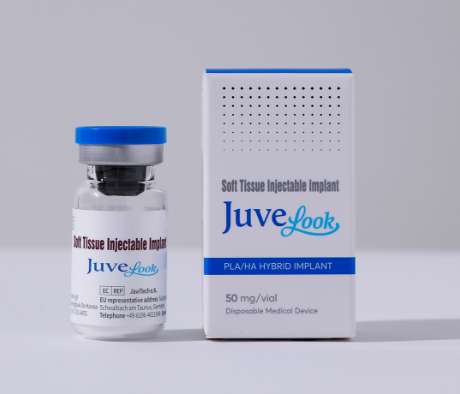
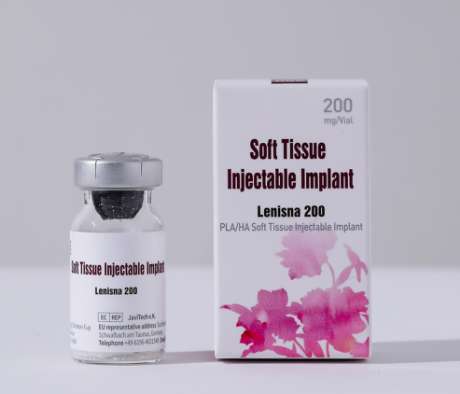
Juvelook (Juvelook) and Lenisna (Lenisna) are formulations whose main ingredient is poly-DL-lactic acid (PDLLA). Poly-DL-lactic acid is produced from extracts derived from starches such as corn, potatoes, and sugarcane. It has excellent biocompatibility and is slowly absorbed in the body over 1–2 years.
During this process, it strongly stimulates collagen production, and is expected to improve skin firmness and radiance, reduce the appearance of pores, improve fine lines, and improve acne scars and other scars.
Juvelook is suited to improving skin quality, while Lenisna is suited to improving volume.
Recommended for those who:
- Are concerned about reduced firmness and elasticity
- Are concerned about enlarged pores
- Are concerned about hollowing at the temples or under the cheeks.
- Are concerned about acne scars or other scars
- Have developing lines between the eyebrows, on the forehead, or at the outer corners of the eyes
What is poly-DL-lactic acid (PDLLA)?
Poly-lactic acid is made by producing “lactic acid” obtained by fermenting starch from corn and tubers. It has excellent biocompatibility with the human body, and is a substance approved by the U.S. FDA for use in the human body.
Poly-lactic acid (PLA) is classified into multiple types of PLA by changing its chemical structure (PLA, PLLA, PDLLA).
Among injectable products using poly-lactic acid, the PLLA (Poly-L-lactic acid) product “Sculptra” has been used mainly in the United States for over 10 years; however, because its particles are sharp in shape, it can strongly irritate surrounding tissue, and a representative side effect was subcutaneous nodules.
“Juvelook” and “Lenisna” are PDLLA (Poly-DL-lactic acid).PDLLA has round particles with a mesh-like internal structure, making it easier to break down, and because it does not release a large amount of acid, it can be used more safely than PLLA.
Juvelook and Lenisna
Juvelook (Juvelook) and Lenisna (Lenisna) are formulations whose main ingredient is poly-DL-lactic acid (PDLLA).
They have excellent biocompatibility and are slowly absorbed in the body over 1–2 years; during this process, they strongly stimulate collagen production. As collagen increases, they improve skin elasticity, tighten pores, and improve fine lines while adding volume.
Both Juvelook and Lenisna have effects that improve skin texture, but they differ in particle size and concentration.
Because Juvelook has smaller particles and a lower concentration than Lenisna, it is suited to improving the more superficial layers of the skin, and is used to restore firmness and elasticity and to improve fine lines and scars.
Lenisna has larger particles and a higher concentration, so it has an effect of adding volume from deeper subcutaneous layers. It is used for hollowing at the temples or under the cheeks, nasolabial folds, and more.
Juvelook
[Injection depth]
Dermis
[Injection method]
Manual injection by a physician; sharp needle or cannula
[Indications]
- Skin Quality Improvement
- Improves skin firmness, radiance, and elasticity
- Fine lines
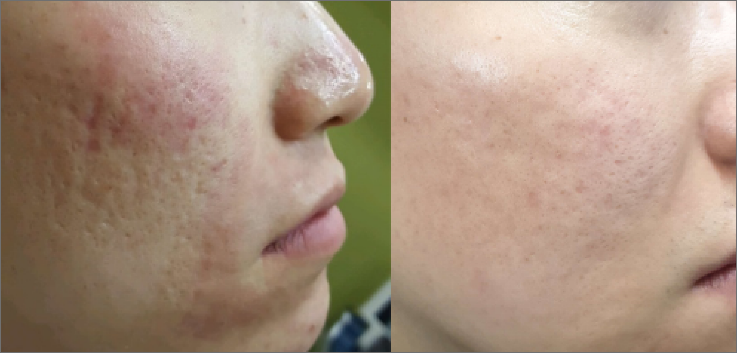
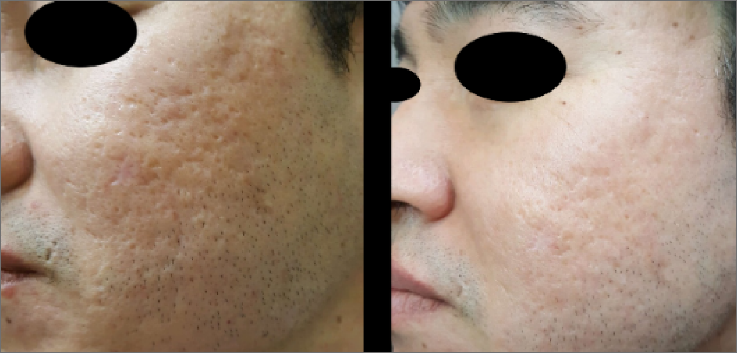
- Acne scars
- Scars
[Estimated treatment interval and number of sessions]
Once every 4 months for 3–4 sessions. After that, maintenance once every 6 months.
Lenisna
[Injection depth]
Subcutaneous
[Injection method]
Manual injection by a physician; cannula
[Indications]
- Hollowing of the cheeks or temples
- Improves skin firmness, radiance, and elasticity
- Deep wrinkles
- Nasolabial folds
[Estimated treatment interval and number of sessions]
Once every 2 months for 2–3 sessions. After that, once every 6 months to 1 year.
Case photos
Treatment details
Treatment time: 60 minutes
| Anesthesia | [Juvelook] Topical anesthesia; block injection upon request [Lenisna] Upon request |
|---|---|
| Possible Side Effects | Redness and swelling may occur immediately after the procedure, but usually subside within a few hours. Bruising may occur. While this varies by individual, it typically subsides in about 1–3 weeks. There is a possibility that “lumps” may occur after some time. In many cases, massage improves “lumps.” If it still does not improve, needle RF will be performed. |
| Makeup | Point makeup is allowed |
| Follow-up visits | None in particular |
| Face washing / shower / bathing | No restrictions |
| Medication | None in particular |
| Contraindications | * Those who are pregnant or breastfeeding * Those with autoimmune disease, malignant tumors, coagulation disorders, or immunodeficiency * Those who have had hydroxyapatite injections such as Radiesse in the area where injection is desired |